Pay yourself first: the 80/20 budget
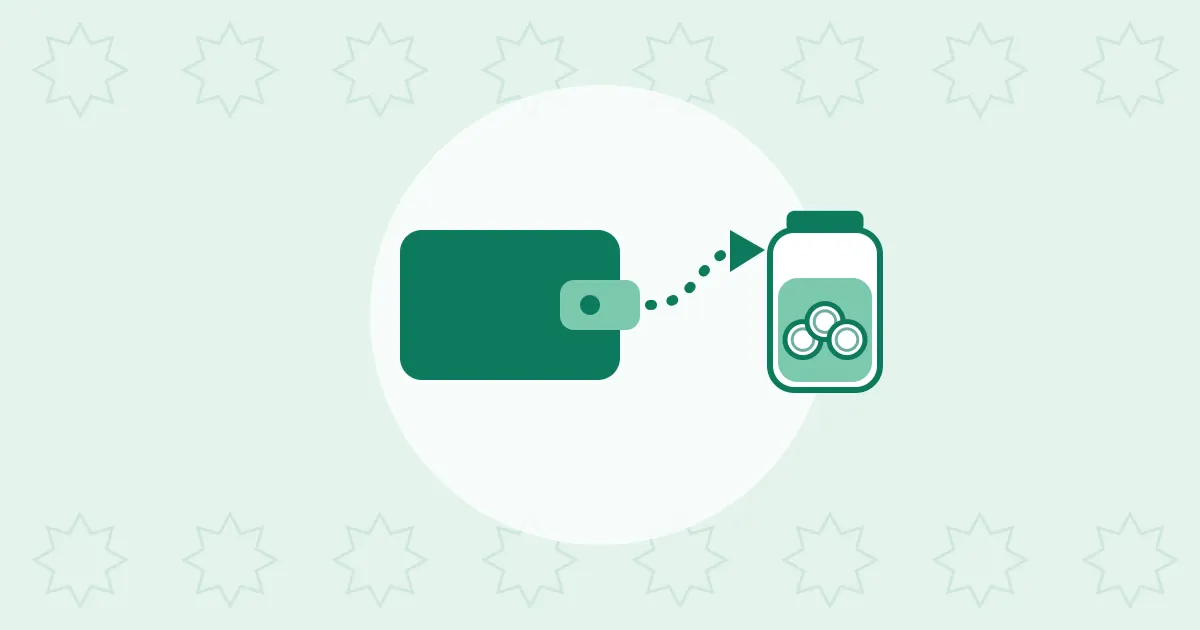
Most people save what is left at the end of the month. The problem is that, very often, nothing is left. “Pay yourself first” reverses the order: savings leave your account on payday, as if they were a bill, and you organise your spending with what remains.
How the 80/20 budget works
The 80/20 budget is the simplest version of this principle:
- 20% of your net income goes to savings automatically on payday;
- 80% covers all your expenses — needs and wants — without detailed categories.
You do not track each expense. You only check one thing: that your current account does not go into overdraft before the next payday. If it does, your expenses are too high and you need to look at them more closely.
An example
Youssef earns $2,800 net per month. On the 1st, a standing order transfers $560 to his savings account. He has $2,240 to live on: rent, bills, food, transport and leisure. At the end of the month, he has $90 left in his current account, which he leaves as a buffer.
In a year, he will have saved $6,720 without ever filling in a spreadsheet.
Why it works
- Behaviour: we adapt our spending to the money we see. Money that has already left the account is not missed.
- Automation: one decision, made once, replaces dozens of daily decisions.
- Simplicity: people who hate budgets can still save regularly.
Put this into practice with your own figures.
Open the plannerWho it suits
The 80/20 budget works well for people whose income comfortably covers their needs and who want a light method. It is less suitable if your needs already take 70% or more of your income: in that case, you need to know precisely where your money goes, and the 50/30/20 rule or a zero-based budget will be more useful.
Its limits
- Annual bills: the 80% must also cover car insurance, taxes and holidays. Without a provision, these bills will push you into overdraft a few times a year. The solution: count the annual bills provision in the 80%, and transfer it to a dedicated account every month.
- No control over the mix: you can save 20% while spending heavily on wants and neglecting needs such as health or maintenance.
- The 20% must be realistic: if it leaves you short every month and you withdraw from savings, it is better to start at 10% and increase gradually.
How to set it up
- Calculate 20% of your net income — or the percentage you can actually sustain.
- Set up a standing transfer for the day after your salary arrives.
- Divide your savings into destinations: emergency fund first, then annual bills, then projects and retirement.
- For a few months, check your current account balance just before payday. If it is regularly negative, review your spending.
- Each time your income increases, raise the percentage by one or two points before your lifestyle absorbs the increase.
Frequently asked questions on this topic
What percentage should I start with?
Start with an amount you are sure to keep up for three months, even if it is 5% or 10%. A small transfer that never fails is better than an ambitious one that you cancel after a few weeks. Raise it each time you receive a pay rise.
Where should the 20% go?
In order: a small emergency fund, the annual bills provision if you have none, then the full emergency fund, your projects and long-term savings. Many people split the transfer into several automatic transfers to different accounts.
Can I combine 80/20 with envelopes?
Yes. The 80% can be split into envelopes for variable expenses such as groceries and outings, while fixed bills go out by direct debit. This gives you the simplicity of 80/20 with a little more control where overspending usually happens.
Good to know — Schedule the transfer for the day after your salary arrives, not at the end of the month. The earlier the money leaves, the less likely it is to be spent.
Using it in the planner
In step 2, choose “80/20 — pay yourself first”. The result panel then shows a single target for spending (needs plus wants, 80%) and a savings target of 20%. You can still enter your expenses in detail to see what makes up the 80%, or simply enter the big items and check that the total fits.
Sources
- Elizabeth Warren & Amelia Warren Tyagi, All Your Worth: The Ultimate Lifetime Money Plan, Free Press, 2005
- Consumer Financial Protection Bureau (CFPB) — Your Money, Your Goals toolkit (budgeting, income, debt)